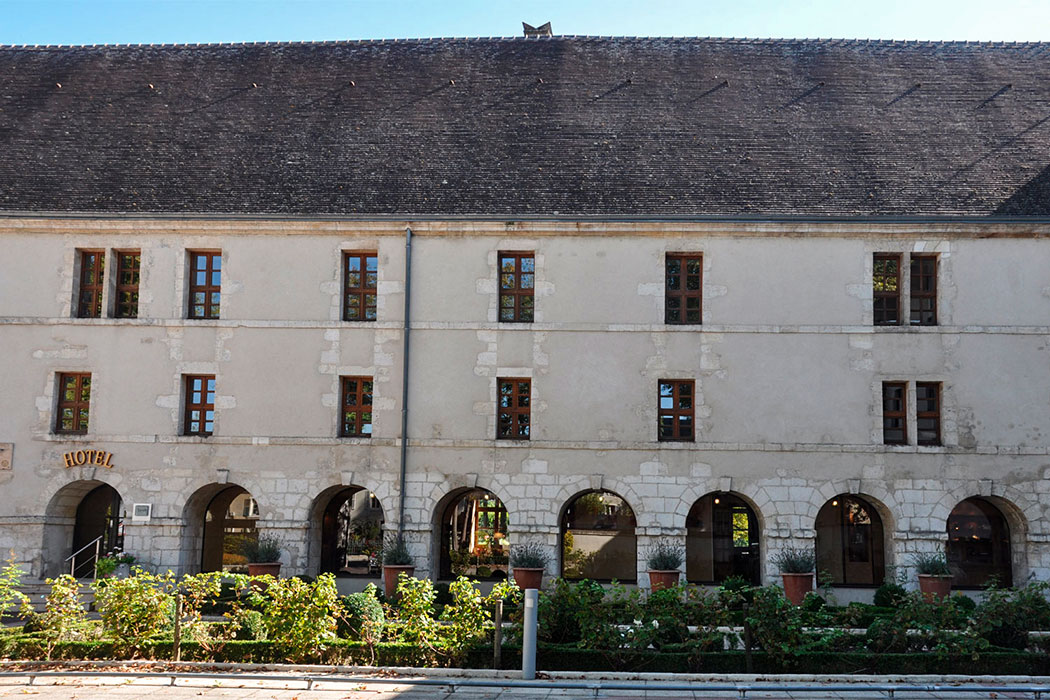

The Augustinian house of Saint-Ambroix occupied the site of an earlier church dedicated to Saint Peter, which is documented as early as 760. That church appears to have been abandoned during the second half of the ninth century, probably as a result of the Norman invasions or, according to some authors, the Hungarian incursions. It is possible that it already served as the seat of a monastery at that time.
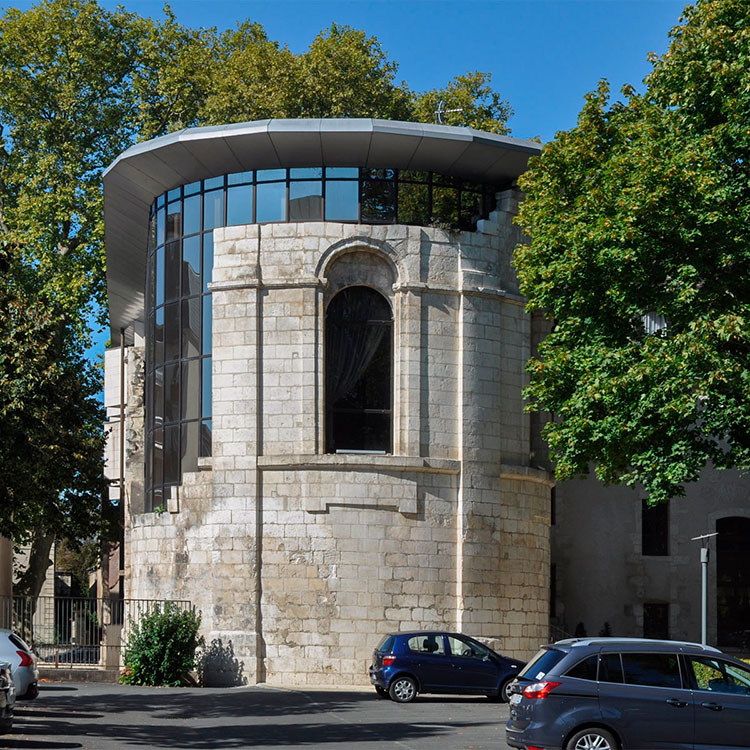
Following the translation of the relics of Saint Ambrose on an unknown date, possibly in connection with the foundation of the canonry in 1012, the church was rededicated to Saint-Ambroix (or Ambroise). Ambrose († 770) was bishop of Cahors during the eighth century. He later withdrew to live as a hermit and, after a journey to Rome, died near the site of the present-day village of Saint-Ambroix. In 1012, the Viscount of Bourges, Geoffroy III le Noble, and his wife promoted the restoration of the church by founding and endowing a chapter of secular canons. The new institution recovered the possessions of the former church and received further endowments.
In 1128, the house became an Augustinian canonry under the authority of an abbot. It was affected by the French Wars of Religion and, in 1562, the church was left in ruins and the saint's tomb was damaged. It later recovered and, in 1636, joined the Congregation of Sainte-Geneviève, which gave it renewed vitality and promoted the restoration of its conventual buildings. The list compiled by the Commission des Réguliers in 1768 records a community of five canons. The canonry was suppressed and sold during the French Revolution, when only three canons remained. The complex was acquired by the public authorities in 1965. The church suffered a fire in 1988. Today, the scant remains are occupied by a hotel.
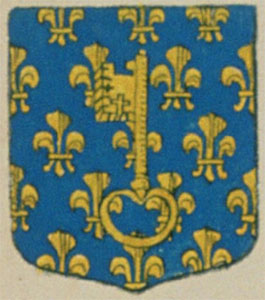
According to Armorial général de France (18th century)
Bibliothèque nationale de France
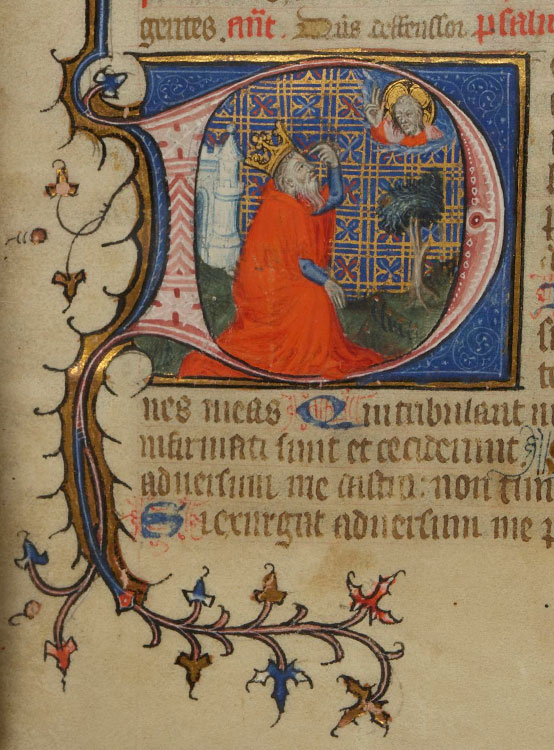
Initial of Bréviaire à l'usage de Saint-Ambroix de Bourges (1380)
Bibliothèque municipale, Bourges. 0016
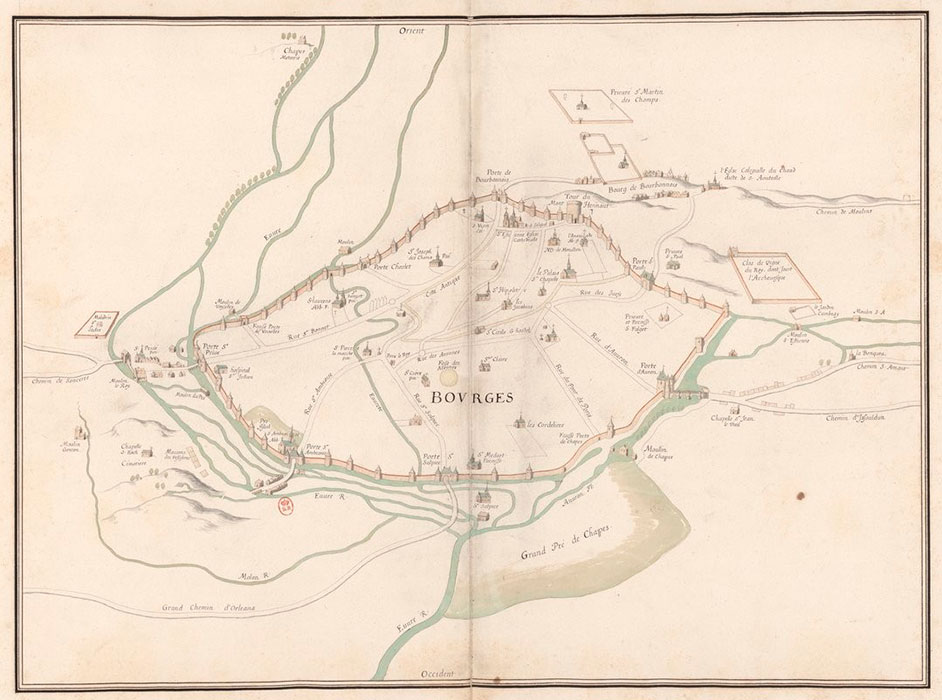
Detail of Bourges (17th century)
Bibliothèque nationale de France
- BAUDRILLART, Alfred (1914, 1938). Dictionnaire d'histoire et de géographie ecclésiastiques. Vol. 2, 10. París: Letouzey et Ané
- BEAUNIER, Dom (1912). Abbayes et prieurés de l'ancienne France. Vol. 5. Bourges. Abbaye de Ligugé
- BUHOT DE KERSERS, Alphonse (1883). Histoire et statistique monumentale du département du Cher, vol. 2. Bourges: Tripault
- GUÉRIN, Paul (1888). Les Petits Bollandistes. Vies des saints de l’Ancien et du Nouveau Testament... Vol. 12. París: Bloud et Barral
- GUILLAUME DE LA CROIX (1879). Histoire des évêques de Cahors, vol. 1. Cahors: Plantade
- MOULIN, Benjamin (2018). Les chapitres collégiaux séculiers du diocèse de Bourges au Moyen Âge de leur fondation à l’aube du XIIIe siècle. Mémoire de Master. Université de Limoges
- SAINT-MAUR, Congregació de (1720). Gallia Christiana in provincias ecclesiasticas distributa. Vol. 2. París: Typographia Regia
- THAUMAS DE LA THAUMASSIÈRE, Gaspard (1865). Histoire de Berry. Vol. II. Bourges: Jollet
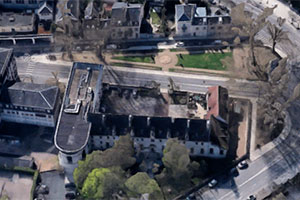
The remains of Saint-Ambroix Abbey stand on the northern side of the historic centre of Bourges