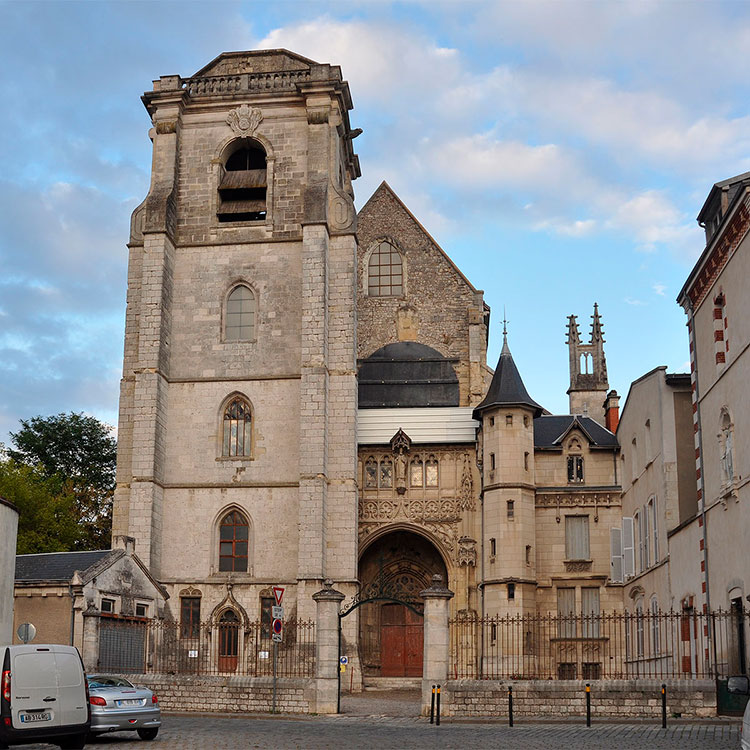


Saint-Euverte Abbey, in the city of Orléans, originated from a community of canons established near the tomb of Bishop Euverte (4th century), where the church of Notre-Dame du Mont was built. According to tradition, in 732 the saint's relics were temporarily hidden in the church of Saint-Étienne to protect them from a possible Saracen invasion. However, it was not until the mid-ninth century that a secular canonical chapter was documented at Saint-Euverte, after the site had been restored.
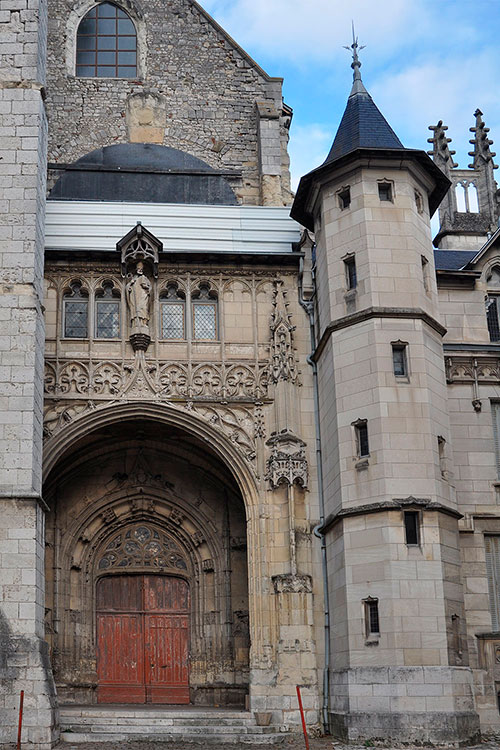
At that time, the canonical chapter suffered from the Norman attacks that affected the city of Orléans. By 865 the establishment lay almost in ruins, but reconstruction began once stability had been restored. The institution maintained close ties with the cathedral chapter of Orléans and with the city's bishops. Despite the recovery of the tomb of Saint Euverte and the restoration works, Saint-Euverte experienced a long period of decline, made worse by a fire in 989. In order to restore the regular life, the community was reformed in 1145 with the arrival of canons of the Order of Saint-Victor, under Roger of Saint-Victor, the first abbot of this new period.
Saint-Euverte then became a regular canonical chapter following the customs of Saint-Victor in Paris. A papal bull issued by Pope Eugene III in 1147 confirmed its new status, while the abbey also received the protection of Louis VII of France (1120-1180). The canons undertook the search for the relics of Saint Euverte, which had been lost after being hidden during earlier conflicts. In 1167 the church was once again damaged by fire, making its reconstruction necessary; the works continued until the end of the century.

Miraculous election of Euverte as bishop of Orleans
Miniature from Speculum historiale
Bibliothèque nationale de France
In 1358, because of the Hundred Years' War, the canons were forced to abandon the abbey, which suffered several destructive episodes, especially in 1428, when the complex once again lay in ruins. In 1488 Charles de Blanchefort became the first commendatory abbot of Saint-Euverte. Further destruction followed in the mid-sixteenth century during the French Wars of Religion. Restoration work was carried out during the seventeenth and eighteenth centuries. In 1636 the abbey joined the Congregation of France. It was finally suppressed during the French Revolution in 1790.
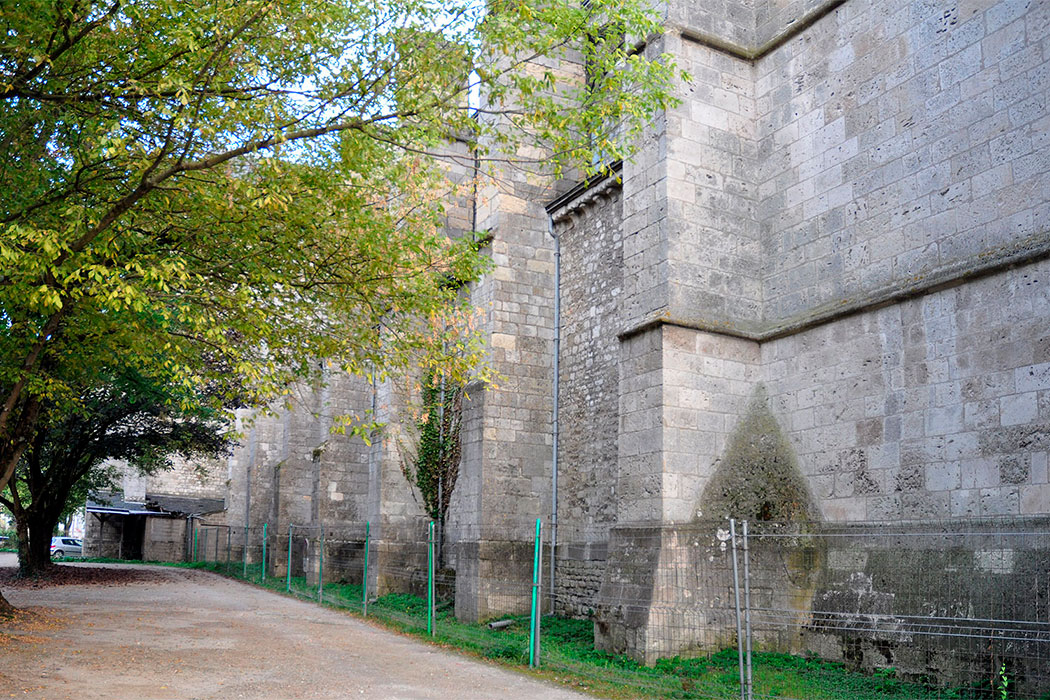
For a short period, the church continued to serve as a parish church, a role it had fulfilled since at least the late fourteenth century. It was later converted into a warehouse and factory. In 1838 it passed into the hands of the Pères de la Miséricorde, who began its restoration in the mid-nineteenth century and remained there until 1880. The complex was subsequently adapted for educational use, a function it still retains today. Despite the many episodes of destruction it has endured, it is the only pre-Revolution monastic establishment in Orléans that still preserves a substantial part of its historic buildings. It is now owned by the municipality and awaits comprehensive restoration.
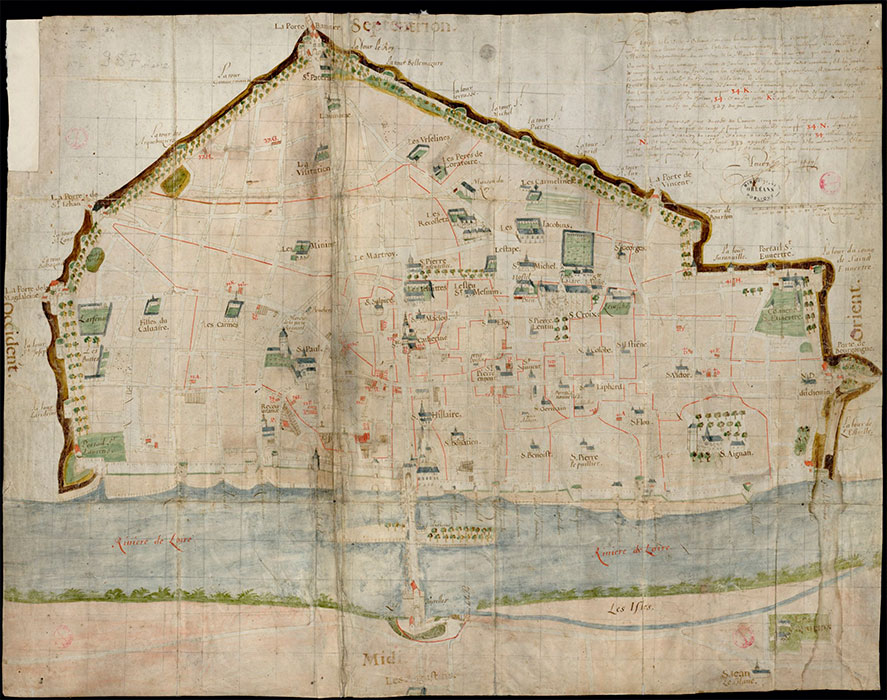
Detail of Jean Fleury's plan (1640)
Médiathèque centre-ville, Orleans
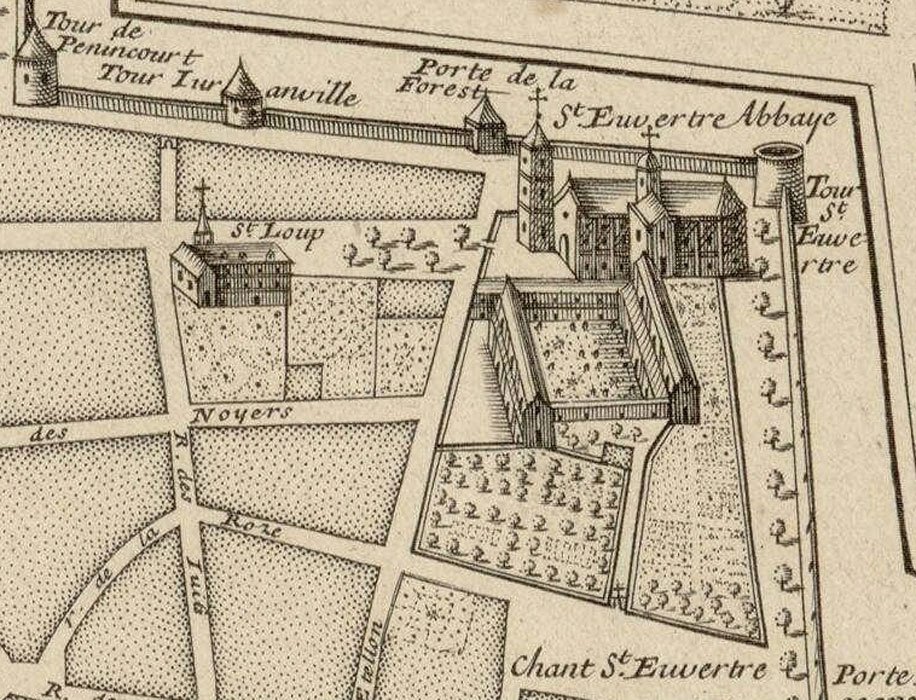
Detail of Plan de la ville d'Orléans (C. Inselin, 1680)
Médiathèque centre-ville, Orleans
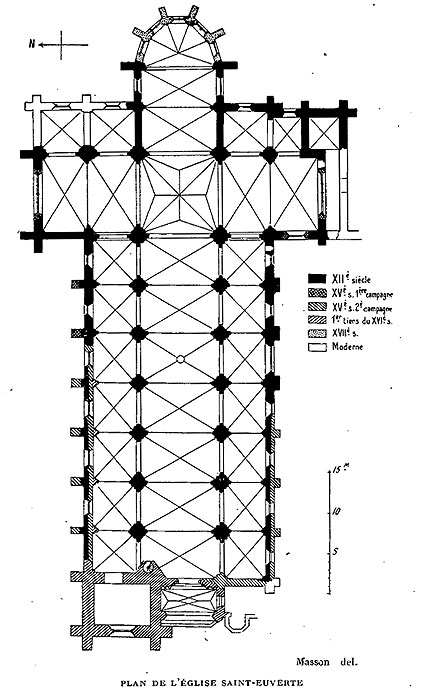
Church floor plan
Published in L'église de Saint-Euverte (1931)
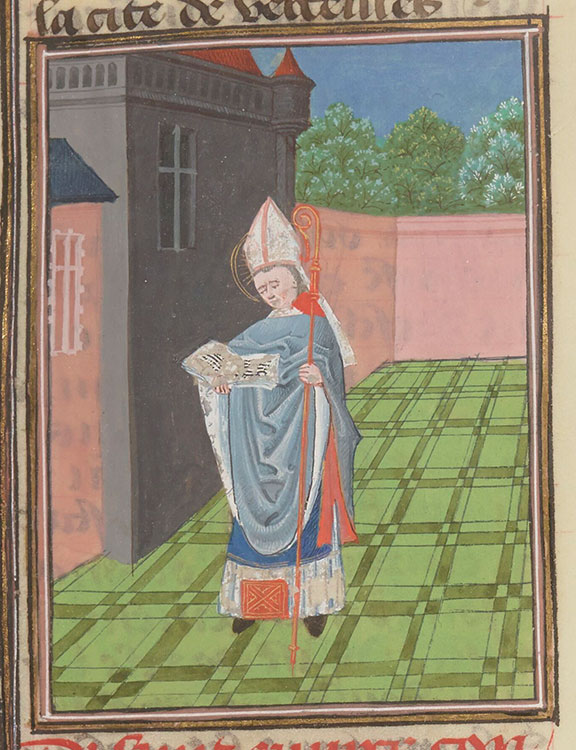
Miniature from Fleur des histoires (15th century)
Bibliothèque nationale de France
Euverte, also known as Evurtius, is regarded as one of the earliest bishops of the Diocese of Orléans. According to tradition, he came from Italy to free his brothers, who were being held captive. At that time, the Christian community had gathered to elect a new bishop, and Euverte was miraculously designated for the office by a dove. During his episcopate he acquired a reputation as a wonder-worker and also built a new cathedral dedicated to the Holy Cross (Sainte-Croix). After his death he was buried in an ancient Roman cemetery, where a chapel dedicated to Notre-Dame du Mont was soon erected.

Old postcard, private collection
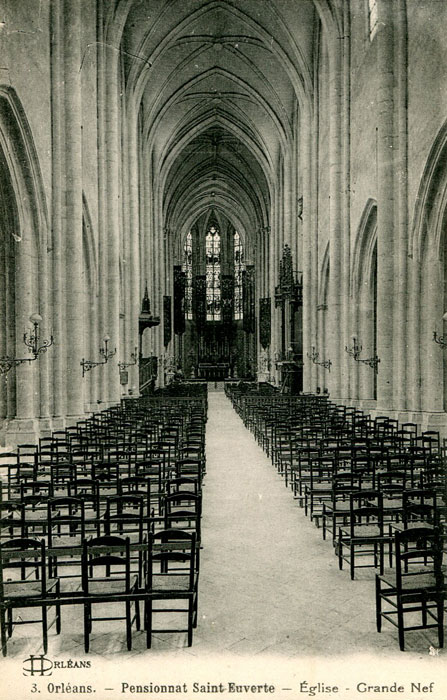
Old postcard, private collection
- ANÒNIM (1855). Légende de Saint Euverte: évêque d'Orléans. Orleans: Saint-Euverte
- BEAUNIER, Dom (1905). Recueil historique des Archêvechés, Évêchés, Abbayes et Prieurés de France. Vol. 1. Province ecclésiastique de Paris. París: Poussielgue
- BERNOIS, Constant (1918). Histoire de l’Abbaye Royale de Saint-Euverte d’Orléans. Orleans
- CHENESSEAU, Georges. (1931). L’église Saint-Euverte. Congrès Archéologique de France. XCIII session. París: Picard
- CHENESSEAU, Georges. (1939). À propos des origines chrétiennes d'Orléans. Revue d'histoire de l'Église de France. Vol. 25. París: Picard
- DUCHATEAU, Eugène (1888). Histoire du diocèce d'Orléans depuis son origine jusqu'à nos jours. Orleans: Herluison
- GUÉRIN, Paul (1888). Les Petits Bollandistes. Vies des saints. Vol. 10. París: Bloud et Barral
- JOURD’HEUIL, Jean-Vincent (2012). De la collégiale extra muros à la cathédrale, lieux de sépulture et mémoire des évêques d’Orléans de l’an mil à la Renaissance. Bulletin de la Société Archéologique et Historique de l’Orléanais, núm. 168
- SAINT-MAUR, Congregació de (1744). Gallia Christiana in provincias ecclesiasticas distributa. Vol. 8. París: Typographia Regia
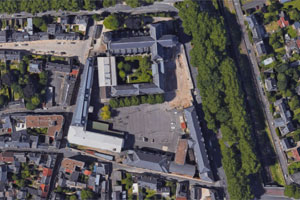
Saint-Euverte stands on the eastern side of the historic centre of Orléans, east of the cathedral