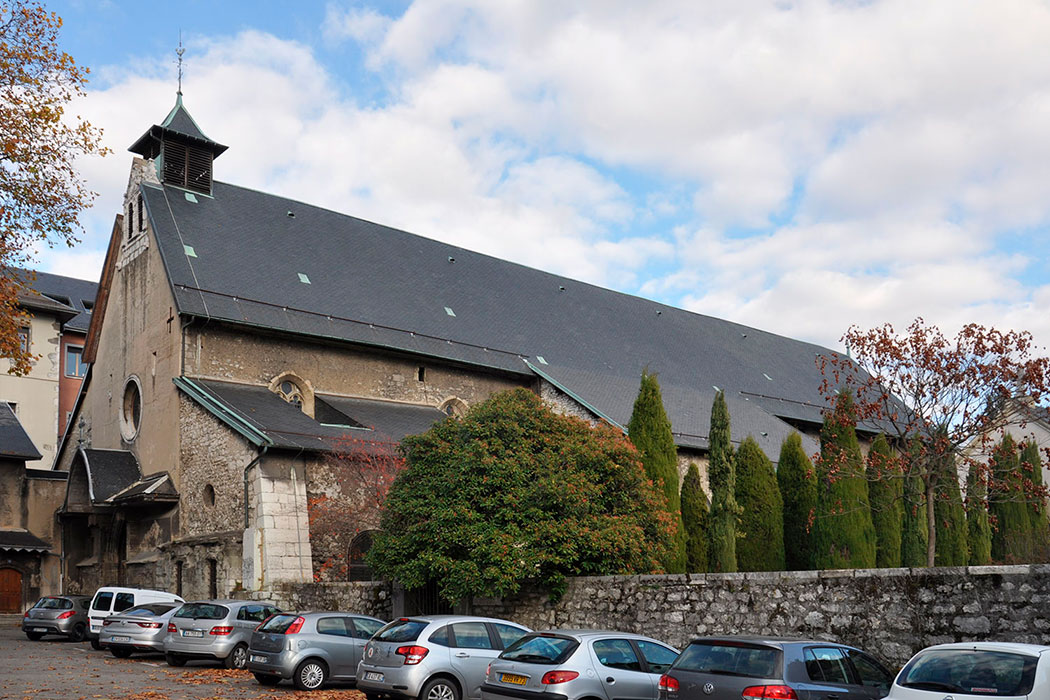


The church of Saint-Pierre de Lémenc is located in Chambéry, on an elevated site where remains of Roman occupation have been discovered, corresponding to the ancient Lemencum. In earlier times, this place already constituted a key communication point between Lyon, Geneva, the Aosta Valley and Piedmont. A Benedictine priory was established here, active from the 11th century until the Revolution.
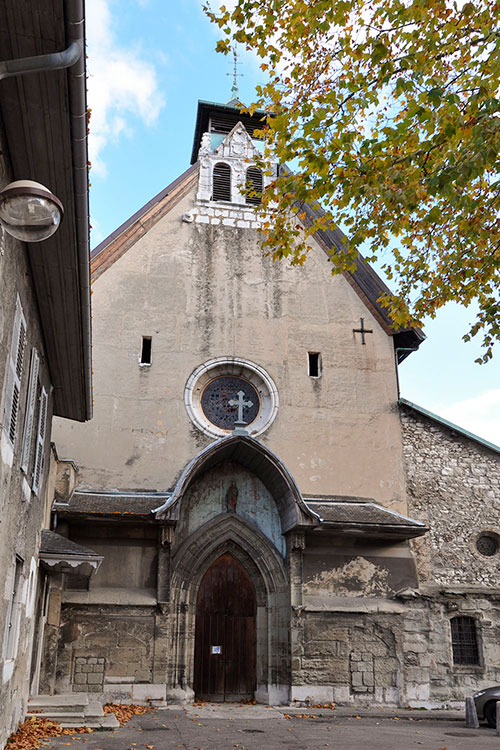
The Benedictine priory of Lémenc was founded in 1029 from the Abbey of Saint-Martin d’Ainay (Lyon). On that occasion, Ainay received an already existing church, granted by Rudolph III of Burgundy (c. 970–1032) and his wife Ermengarda († c. 1057). The possibility that an earlier monastery may have existed on this same site before this donation cannot be excluded. A very late document mentions the foundation of a monastery in 546, with the involvement of Saint Anselm, abbot of Ainay. The surviving documentation concerning this house is scarce; it is known that in 1138 Pope Innocent II signed a document confirming the possessions of the priory.
In 1448 Duke Amadeus VIII of Savoy (1383–1451), proclaimed antipope under the name Felix V, confirmed the possessions of Ainay, among which was this priory of Lémenc. Following a fire, the rebuilding of the church of Saint-Pierre began at the end of the 15th century. In 1603, a bull of Pope Clement VIII introduced into the house monks of the Cistercian branch known as the Feuillants, replacing the Benedictines. It is also mentioned that the site belonged to the Order of Saints Maurice and Lazarus.
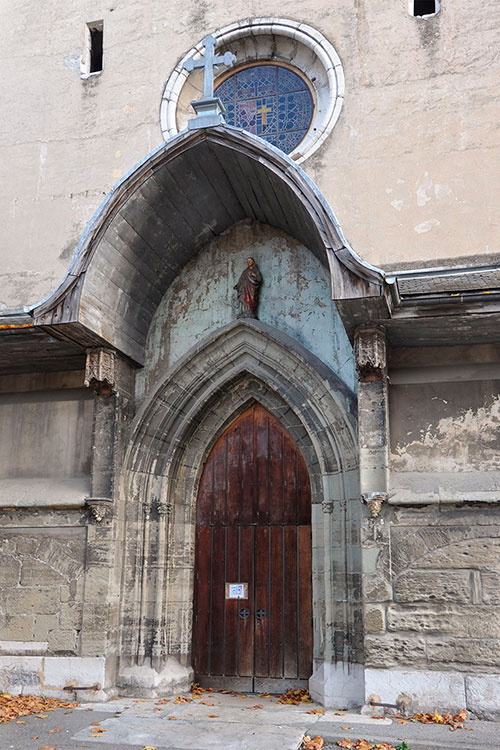
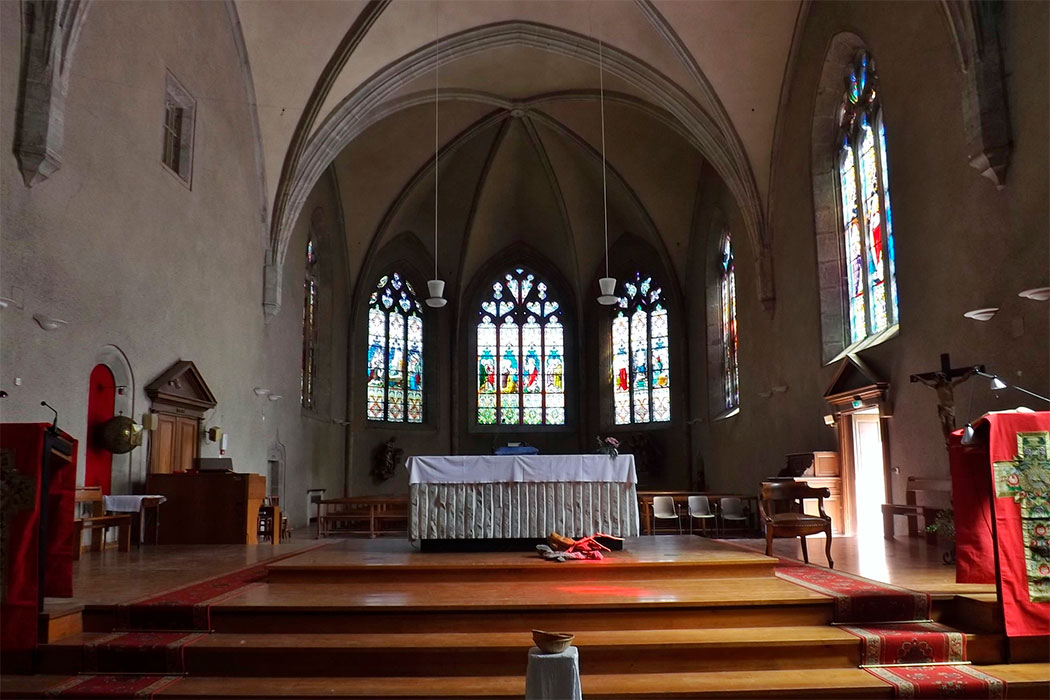
Photo by Florian Pépellin, on Wikimedia
After the Revolution, the complex suffered damage and in 1799 passed into private hands. It was later occupied by other religious institutions until 2013, when restoration work began. The present church, built between the 15th and 16th centuries, is still preserved, together with some elements from the earlier building. The site has undergone numerous interventions throughout its history.
Special mention should be made of the crypt, which also reflects the successive building phases. The oldest part is a rotunda formed by six columns arranged in a circle and surrounded by a circular ambulatory. This rotunda communicates, through three aisles, with the space beneath the apse of the church, whose vaults rest on four columns. The rotunda has given rise to various interpretations regarding its function—perhaps a baptistery or the remains of a pre-Romanesque circular building. The aisles connecting it to the apse may have been built with the arrival of the Benedictines, during the first half of the 11th century. The apsidal section corresponds to the reconstruction carried out between the 15th and 16th centuries.
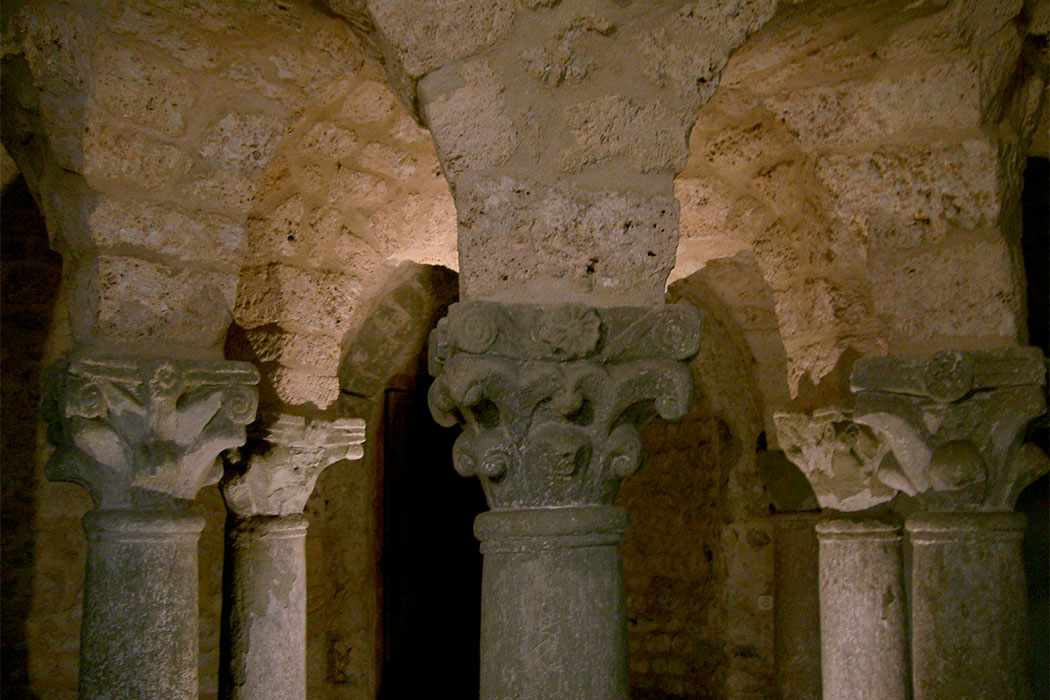
Crypt rotunda
Photo by francois73, on Wikimedia
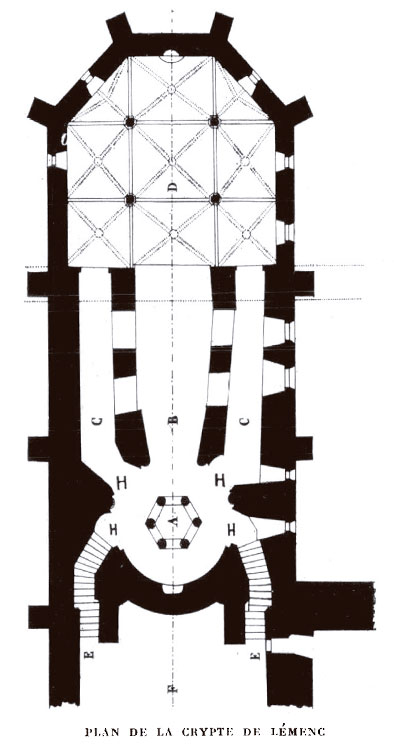
Crypt plan
Illustration from Bulletin Monumental, 116
- BAUDRILLART, Alfred (1953). Dictionnaire d'histoire et de géographie ecclésiastiques. Vol. 12. París: Letouzey et Ané
- BESSE, J.-M.; i altres (1939). Abbayes et prieurés de l'ancienne France. Vol. 9: Province ecclésiastique de Vienne. Abbaye de Ligugé
- CHAGNY, André (1935). La basilique Saint-Martin d’Ainay et ses annexes. Lyon: Masson
- DELESALLE-HUVÉ, Valérie (2019). La crypte de l’église Saint-Pierre de Lémenc (Chambéry) : étude documentaire et archéologique. Mémoire de Master, Université Grenoble Alpes
- PERRET, André (1965). L'église et la crypte de Lémenc. Congrès archéologique de France. 123 ss. Société française d'archéologie
- RAYMOND, Georges-Marie (1830). Notice historique sur l’église de Lémenc, près de Chambéry. Mémoires de la Société royale académique de Savoie, vol. 4
- SALET, Francis (1958). La crypte de Lémenc. Bulletin Monumental, vol. 116
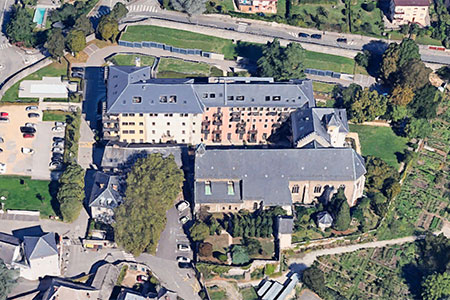
Saint-Pierre de Lémenc stands on elevated ground, on the northern side of the urban centre