Abbey of Saint-Martin de Savigny
Saviniacum / Savigniacum / S Martini Saviniacensis
(Savigny, Rhône)
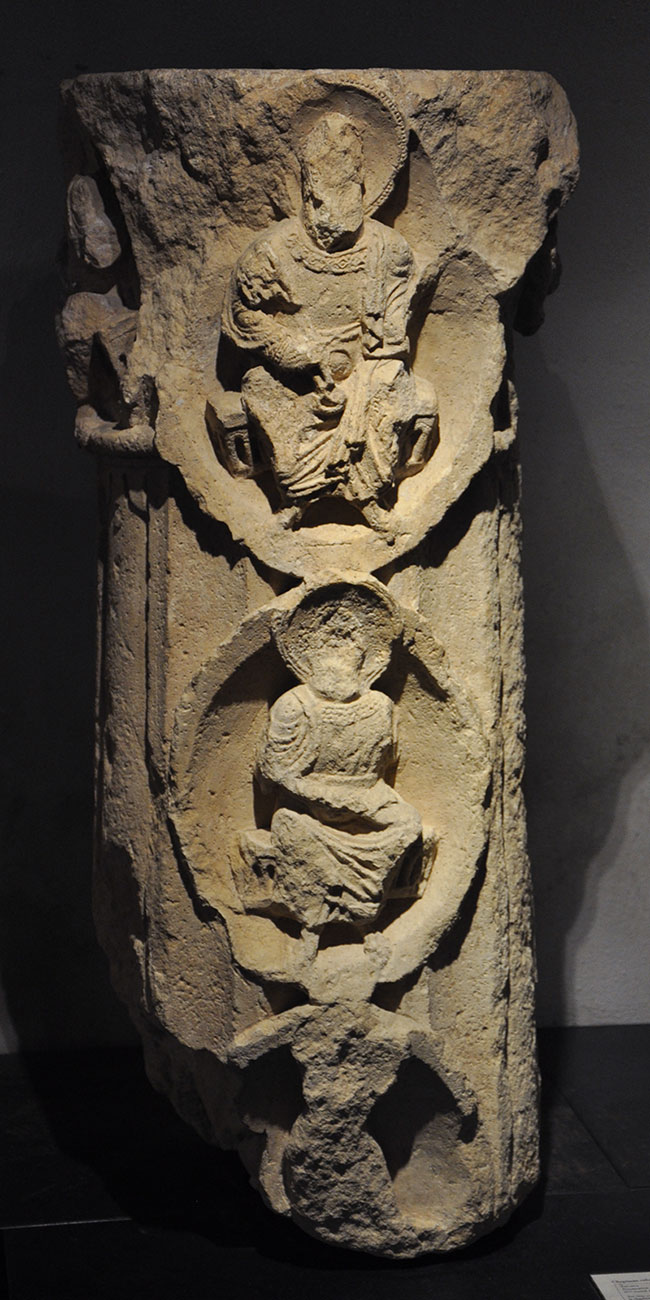
Column capital with Saint Peter (12th century)
Gadagne Museums, Lyon

Although various legends place the origin of the monastery at different periods from the fifth century onwards, its existence is not securely documented until 817, when it already functioned as a Benedictine monastery. It appears to have been a Carolingian foundation, though the identity of its patron remains unknown; one traditional account attributes its foundation to Charlemagne. In 852, Lothair I (795–855) granted it to Rémi, Archbishop of Lyon († 875), to whom he was related.
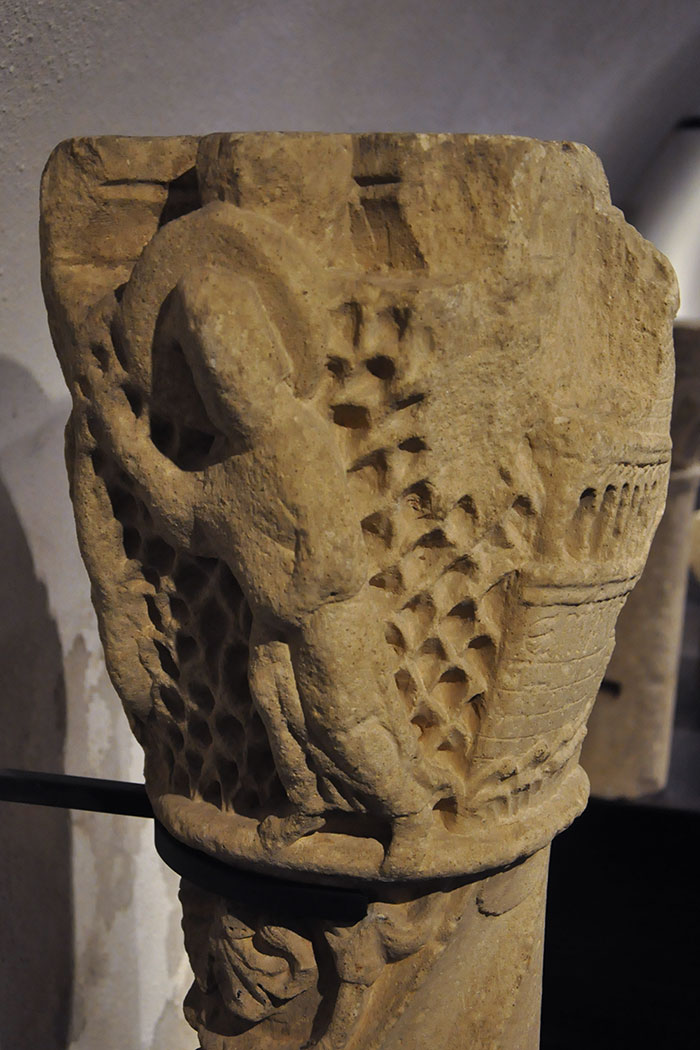
Capital of the Pilgrims at Emmaus (12th century)
Gadagne Museums, Lyon
Around 934, the monastery fell victim to an incursion by the Hungarians, possibly at a time when it was already in decline. Nevertheless, by about 940 the community had been restored under Abbot Badin, regarded as the driving force behind its monastic revival, in a context closely associated with the Cluniac reform. During the abbacy of Gausmar (c. 954–984), the house experienced a notable expansion, marked by the confirmation of its possessions and the arrival of relics from the Holy Land. After his death, Gausmar was venerated as a saint, following several miraculous episodes attributed to him. In the eleventh century, the monastery reached the height of its prosperity, and it continued to enjoy a certain degree of expansion thereafter.
This was followed by a generally prosperous period, interrupted by phases of decline and restoration, notably as a result of the Hundred Years’ War. A subsequent phase of decay set in, and in 1562 the Wars of Religion severely affected the region; the monastery was occupied by Calvinists, leading to the loss of a significant part of its archives. In the eighteenth century it suffered from poor internal governance under a regime of non-resident commendatory abbots. In 1766, the monks themselves requested secularization, which was decreed by Louis XVI in 1779 and implemented the following year.
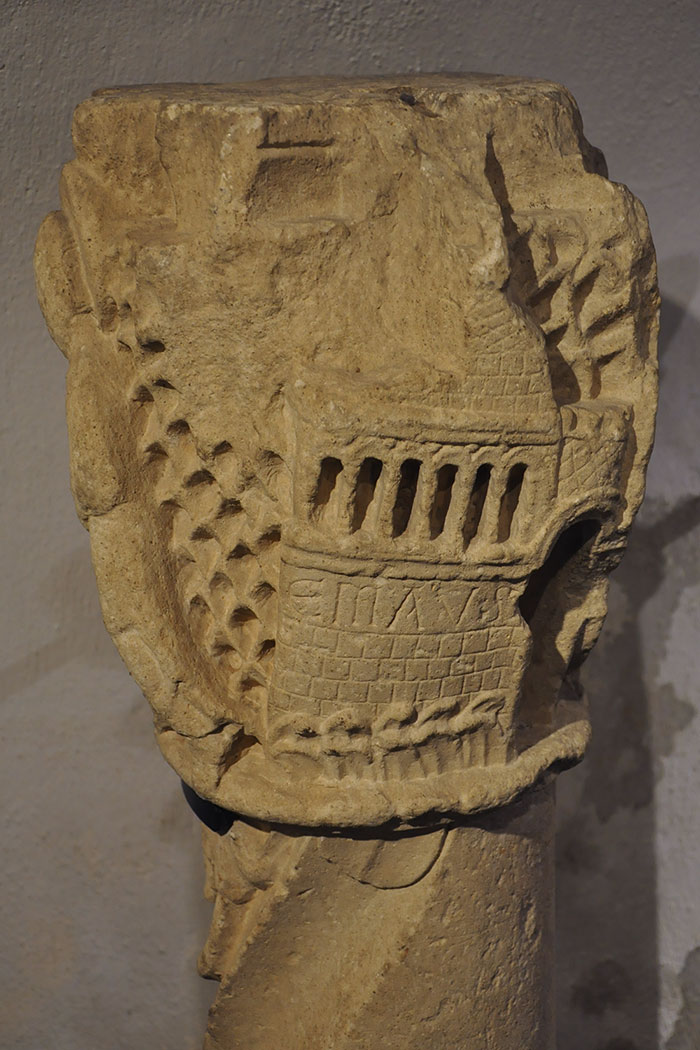
Capital of the Pilgrims at Emmaus (12th century)
Gadagne Museums, Lyon
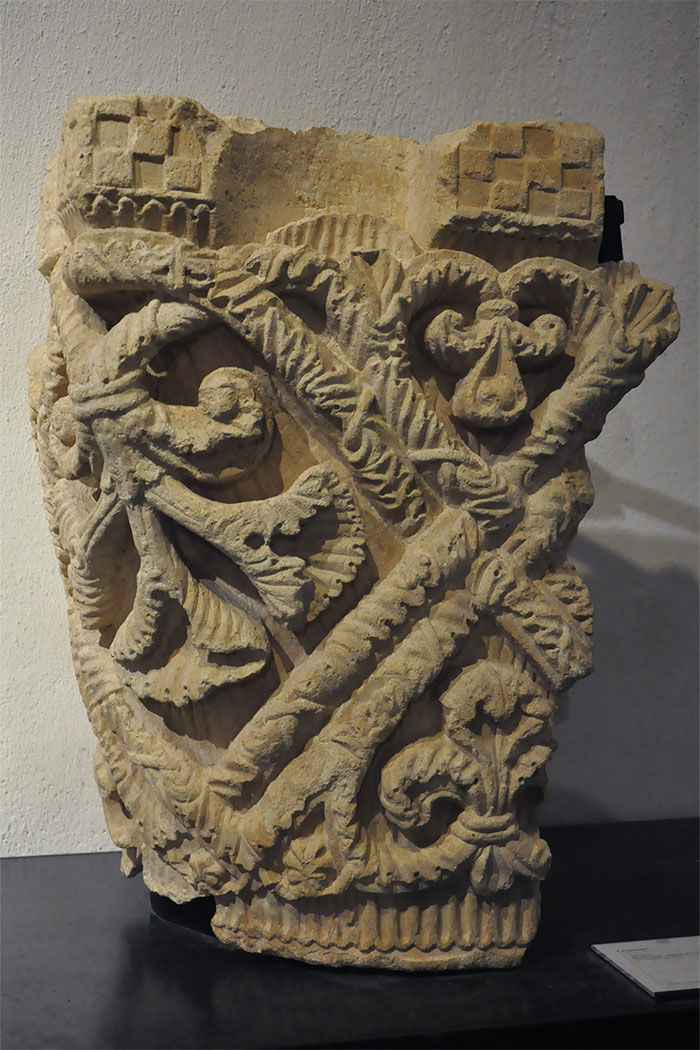
Capital (12th century)
Gadagne Museums, Lyon
At the time of the Revolution, a few monks still lived on the site, though without any strictly monastic activity. The complex was rapidly dismantled during the first half of the nineteenth century and, even later, its remaining buildings continued to disappear. Today, only a few architectural remains survive, notably the entrance tower, along with sculptural fragments preserved in Savigny itself and at the Gadagne Museums in Lyon.
Column capital (12th century)
Gadagne Museums, Lyon
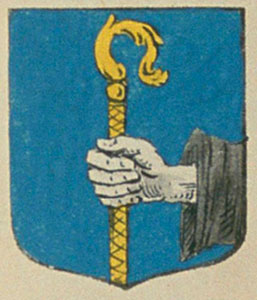
According to Armorial général de France (18th century)
Bibliothèque nationale de France
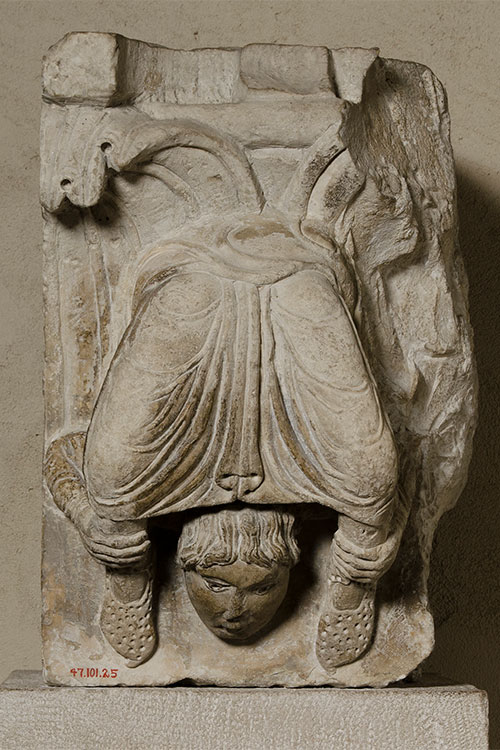
Acrobat (12th century)
The Cloisters (New York)
- BERNARD, Aug. (1853). Cartulaire de l'Abbaye de Savigny. Suivi du Petit cartulaire de l'Abbaye d'Ainay. París: Imp. Impériale
- COTTINEAU, Laurent-Henri (1939). Répertoire topo-bibliographique des abbayes et prieurés. Vol. 2. Mâcon: Protat
- PUEL, Olivia (2013). Saint-Martin de Savigny : archéologie d’un monastère lyonnais. Tesi doctoral. Université Lumière Lyon 2
- PUEL, Olivia; GANIVET, Pierre (2016). Les origines de l’abbaye lyonnaise Saint-Martin de Savigny. Bulletin du centre d’études médiévales d’Auxerre
- SAINT-MAUR, Congregació de (1725). Gallia Christiana in provincias ecclesiasticas distributa. Vol. 4. París: Typographia Regia
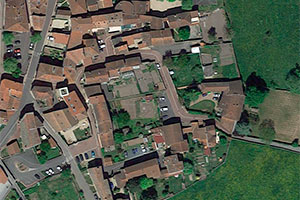
The monastery, now almost entirely lost, stood at the centre of the town of Savigny (Rhône), to the west of Lyon